Don’t let your resolution fail!
New Year resolutions date back to 4,000 years ago:
- Babylonians pledged to pay their debts.
- Brazilians jump seven waves and make a wish at each wave.
- Colombians eat a grape each time the clock chimes at midnight.
- Argentinians shred old documents to leave the past behind.
- Buddhist countries ring bells in the streets to wish “good luck”.
Losing weight, exercising more, and staying fit are resolutions that many Americans make. It’s probably not too difficult to start an exercise / healthy eating program, but the trick is to stick to it. Make it a habit.
Try not to obsess about the outcome; concentrate on doing something every day that is within your control. To stick to your resolution, keep it simple.
Start now:
- Get more active.
- Cut down on junk (food)
A pound of fat contains 3,500 calories. To lose weight, try reducing caloric intake by 350-500 calories along with exercising each day (burning about 350 to 500 calories). This will provide for a reasonable and maintainable weight loss through life style change.
Try this tasty nutritious recipe for a start: http://://nancylfitness.com/2013/01/31/whole-wheat-pasta-with-chicken-asparagus-and-tomatoes/
In terms of exercise, the ACSM (American College of Sports Medicine) recommends at least 30-60 minutes of moderate physical activity five or more days a week. However, studies have shown that even small amounts of activity/exercise are beneficial. Any exercise helps to improve health because it:
- Strengthens bones
- Increases muscle tone
- Reduces the risk of some diseases
- Elevates mood.
Just 10 minutes of exercise a day will bring positive results. Try to work several major muscle groups at the same time. Once started, stick with the program. Routine exercise is one of the best things you can do for your health. You will:
- Be more energized
- Boost your ego
- Elevate metabolism
- Sleep better
- Lose / maintain weight
- Improve brain function
- Decrease risk of cancer / cardiovascular disease.
Everyday activities and recreation burns calories. Any extra movement/activity counts toward health benefits:
- Take the stairs – instead of the elevator or escalator
- Park further away in the parking lot
- Iron, wash dishes, cook
- Rake leaves
- Walk the dog.
NOTE: For safety purposes talk to your doctor about any physical limitations you may have when starting an exercise program. Use dumbbells or other weighted household item such as liter water bottles as weights.
To begin, try the exercises below:
Standing dumbbell push press
Works shoulders, triceps, legs & glutes (buttocks).
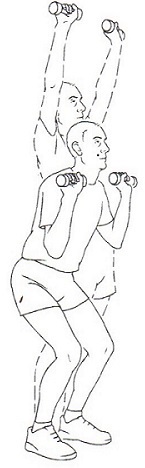
- Stand.
- Hold weights at shoulder level.
- Dip knees.
- Straighten body driving weights straight overhead.
- Complete 20 reps (repetitions).
When this movement becomes too easy, add more reps and/or more weight.
Dumbbell stiff legged deadlift with lateral raise upon standing
Works low back, glutes, hamstrings (legs), abs (abdominals), deltoids (shoulder), traps (trapezius), rotator cuff & core.
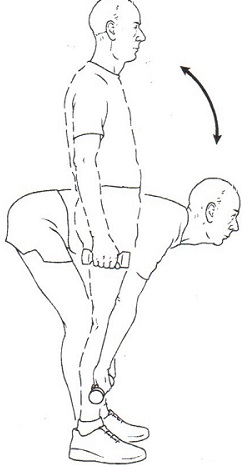
- Stand, holding weights at each side with knees slightly bent.
- Bend at the waist & lower weights to ankles while keeping back flat.
- Return to erect posture; raise right foot to result in standing on left leg.
Lateral raise (single leg)
Works the shoulders (lateral deltoids), with the trapezius (upper back) and balance.
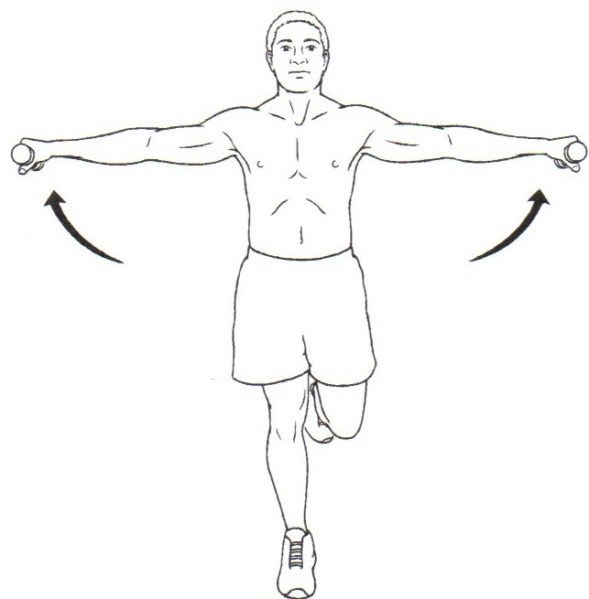
This exercise involves lifting weights away from your body, out to the side while standing on one leg.
- Standing on left leg hold weights at each side.
- Raise arms out from sides to shoulder height; lower weights to sides.
- Repeat while standing on right leg.
- Repeat process for 20 reps or as many as possible.
- Increase reps and/or weight as strength increases.

