
Stretching helps to improve a muscle’s elasticity, tone and flexibility. It also works to enhance balance and increase blood circulation. By warming up the muscles and raising the heart rate (HR), stretching prepares the body for exercise with improved physical performance.
Stretching also increases production of synovial fluid that reduces friction in certain joints and helps to improve range of motion (ROM). ROM is the ability of a particular joint to move. Pain, swelling, and stiffness associated with arthritis can limit the range of motion of a particular joint, reducing function and the performance of everyday activities. Stretching Helps!
Without stretching, muscles shorten becoming tighter and weaker. When muscles cannot extend all the way it creates pain. This shortening can cause a reduction in ROM and flexibility, increasing the risk for injury. Driving, sitting in a chair and/or looking at a screen will cause muscles to become tighter.
As we age, muscles begin to lose strength and power and decrease in mass; endurance declines. Flexibility becomes more limited. Stretching helps to counteract this age-related deterioration.
Definitions:
- Dynamic stretching includes movement. These are controlled movements designed to prepare muscles / ligaments / soft tissue for performance and safety.
- Static stretches – where one stands, sits or is prone in a still position. This position is held for a for period of time (up to ~ 45 seconds). Static stretches are typically performed at the end of an exercise session. It helps to realign the muscles.
Static and Dynamic stretching have different purposes and are employed at different times in a workout.
Ideally, before an exercise routine, warm-up with about 10 to 15 minutes of light aerobic exercise (walking, biking, eliptical trainer, etc.) before stretching. Then do about 10 minutes of dynamic stretching: slow controlled movements through the full range of motion. Risk of injury is reduced by performing these movement stretches.
At this point the muscles are warmed up and ready for your particular exercise routine. After the exercise routine is completed perform static stretching to realign your muscles and to cool down, bringing your HR back to normal.
After any physical activity, there can be a build-up of lactic acid. Stretching helps to reduce the level of lactic acid, helping to alleviate muscle pain and/or cramps. Stretching does increase flexibility, however, stretching can be precarious when performed incorrectly. Following the guidelines outlined below will help to maintain proper form and function.
General Stretching Guidelines
- Move the designated body part to a position of MILD stretch.
- If possible, increase the stretch to a position of mild discomfort but NOT pain.
- Maintain normal, relaxed breathing throughout the stretch. DO NOT hold your breath.
- If you feel unbalanced while doing a standing stretch, brace yourself with one hand, using a firm support such as a counter top, wall or heavy piece of furniture.
Stretches to try:
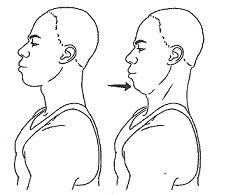
- Stand or sit with head in a comfortable position.
- Draw in chin pulling head straight back. Keep jaw and eyes level.
- Hold this position for 5 to 7 seconds. Release.
- Repeat
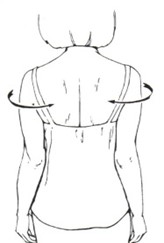
- Sit straight and errect.
- Draw shoulders back, bringing elbows back and inward.
- Hold for 6 seconds.
- Repeat 4 to 6 times.
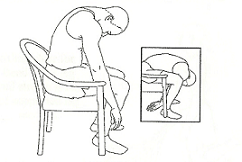
- Siting in a chair with knees apart, bend forward toward the floor.
- Feel the stretch in the lower back.
- Hold 7 to 10 seconds.
- Sit upright.
- Repeat.

- Sit on edge of seat, one hand on opposite knee, other hand on chaIr.
- Keep feet parallel.
- Pull with hand on knee. If needed, push with hand on chair to rotate trunk to that side.
- Hold 7 to 10 seconds.
- Repeat on other side.
- Do 2 to 4 rotations on each side.
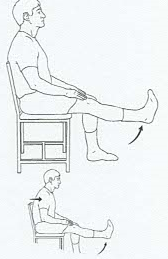
- Sitting in a chair, lift one leg off the seat.
- Extend it out straight. Hold for 2 seconds.
- Lower foot – do not touch floor – hold for several seconds.
- Switch.
- Do each leg 10 to 15 times.
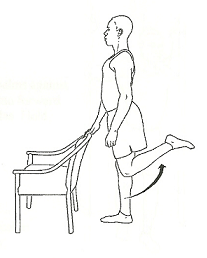
- Stand, using chair as support if needed.
- Slowly bend left leg feeling the stretch.
- Hole for 7 to 10 seconds.
- Release.
- Repeat with other leg.
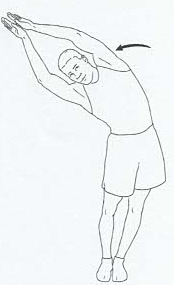
- Stand with feet together and palms overhead touching.
- Bend body to one side as far as possible.
- Hold 5 to 7 seconds.
- Resume original position.
- Bend body to the other side as far as possible.
- Hold 5 to 7 seconds.
- Resume original position.
 Nancy L. Fitness