
In the first installment of this series we talked about the muscles that activate the hip joint and explained that stretching and exercising these muscles helps to manage pain. By strengthening the tissues surrounding the hip, strain on the bones of the hip is decreased, thus increasing mobility. Any knee and leg pain may also be improved as these muscles, ligaments and tendons become stronger.
As stated in the first section of this hip series, the muscles that activate the hip joint include the quadriceps, hamstrings, glutes, and adductors. The table below provides an explanation of the function of these various muscles and how they work at the hip.
| Function | Movement | Muscles Involved * |
| Flexion | Taking a step; Bringing knee to chest. | Psoas major, Iliacus Pectineus, Rectus femoris, & Sartorius |
| Extension | Standing up; Moving thigh backward. | Gluteus maximus Hamstrings |
| Medial Rotation | Inward rotation of thigh and leg; Extend lower leg at knee. | Tensor Fascia Latae (TFL); Gluteus medius and minimus. |
| Lateral Rotation | Rotates a limb away from the midline of the body. Balance; Proper gait. | Obturator muscles, Quadratus femoris, Gemelli; Gluteus maximus, Sartorius, and piriformis. |
| Adduction | Movement of leg toward midline of body. | Adductor Longus, Brevis, and Magnus. |
| Abduction | Motion of an arm or leg away from midline of the body. Leg: moving leg away from the body. | Gluteus Medius and Minimus; Tensor fascia latae and sartorius |
Muscles Involved * Psoas major: located deep in the body close to each side of the spine, stretching to the lower pelvis; Iliacus: inner hip muscle at hip joint; Pectineus: in the upper portion of the thigh; Rectus femoris: called the “kicking muscle” is part of the quadriceps at front of thigh; Sartorius: starts at the top of the thigh and goes down to just below the knee (longest muscle in the body); Gluteus maximus: located in the buttocks (heaviest muscle in the body); Hamstrings: a group of 3 muscles located in the back of the thigh; Tensor Fascia Latae (TFL): The TFL located on the outside of the hip; Gluteus medius & minimus: located in the buttocks, combines with the Gluteus maximus to form the “Glutes”; Obturator muscles: starts in the pelvis and goes to the top of the thigh bone (femur); Quadratus femoris: located at the back of the hip joint; Gemelli: located deep in the pelvis; Piriformis: located in the buttocks; Adductor Longus, Brevis, and Magnus: muscles in the upper thigh.
Exercise can help improve movement in the hip. To avoid injury be careful not to over-train. Below are exercises designed to enhance hip movement.
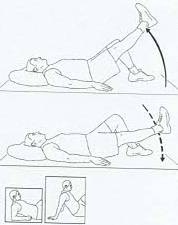
Knee lifts stretch your hip flexors, thigh muscles, and gluteal muscles. Strengthen the quadriceps without putting pressure on the knees.
- Lie on your back with the right leg outstretched and straight, the left leg is bent with that foot flat on floor.
- Lift the right leg to level with bent (left) knee.
- Hold this position for 10 to 15 seconds.
- Slowly lower right leg.
- Repeat on the other side.
- Complete 6 to 8 reps on each leg.
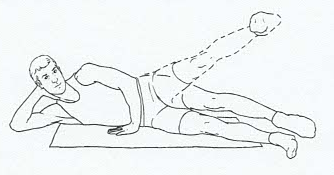
This exercise works to strengthen the outer thighs, hips, and backside and improves the range of motion in the hips and stability.
- Lie on right side: back straight, legs at ~ 300. Prop upper body with bent elbow.
- Flexing foot lift top leg up as high as you can without bending body or leg.
- Hold the position for five seconds, then point foot and lower the leg.
- Repeat this 6 to 8 times
- Then turn over to left side; repeat with other leg.
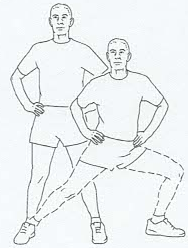
Stretches the inner thigh adductor muscles, quadriceps, and gluteal muscles.
- Stand tall with head up and back flat, feet slightly more than shoulder width apart, toes forward.
- Keeping left leg straight, bend right knee and step out to the right side. Keep your chest up and core engaged the entire time.
- Bend knee/leg until thigh is about parallel to the floor.
- Hold position for 3–4 seconds.
- Return to start position by pressing through your heel and engaging glutes.
- Complete 6 to 8 reps on each side
Use a support, if needed. A support allows for a greater range of motion than performing the exercise unsupported.
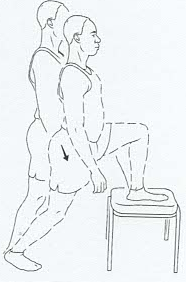
- Stand with one foot on a chair.
- Slowly shift weight toward raised knee until stretch is felt in quadriceps of the standing (plant) leg and hamstrings of forward leg. Use a support, if needed.
- Hold this position for 7 to 10 seconds.
- Return to starting position.
- Repeat on the other leg.
- Complete 4 to 6 reps on each leg.
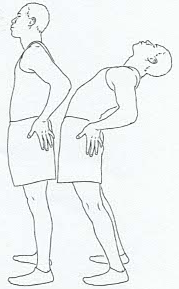
- Stand straight with feet a little wider than shoulder-width apart, place hands on glutes (buttocks). Keep body relaxed and face forward
- Press hips forward, arching back.
- Hold this position for a few seconds, and then return to start.
- Do this stretch 2 or 3 times.
 Nancy L. Fitness