
Our bodies are not designed to sit all day.
Immediately after sitting down, muscle electrical activity and metabolism slow down, as a result less calories are burned. Only 1 calorie per minute is burned while sitting. That is 1/3 of what the body burns when walking.
After a prolonged period of this lifestyle, LDL cholesterol (bad cholesterol) increases and weight gain occurs. After just two weeks of sitting, muscles begin to atrophy and oxygen consumption decreases, making it more difficult to climb stairs and walk longer distances.
Sitting for long periods of time (10 hours or more per day) also has a negative effect on health: circulation decreases, muscles tire, and tasks become more uncomfortable to perform. Hip flexor and hamstring muscles begin to tighten. Tight hamstrings make it difficult to extend the leg (straighten knee). This inhibits walking.
As we sit at the computer our shoulders are usually forward and we are hunched over for extended periods of time. This can cause pain and tightness in the back and neck, tingling in the extremities and poor posture. Incorrect computer posture habits combined with long-term sitting may cause medical problems.
While sitting, the large muscles become relaxed. Relaxed muscles do not take up very much glucose from the blood. As a result, the risk for Type II diabetes increases along with heart disease and some cancers. It has also been shown that in women bone mass can drop by 1% after a year of sitting for 6 hours a day.
To reduce these effects of long term sitting; take breaks; switch things up:
- Stand every 45 minutes to 1 hour (set alarm or timer). Standing up for 1 – 2 minutes every hour will reduce the negative effects of sitting all day.
- March in place for twenty seconds.
- Reach down and try to touch your toes for twenty seconds.
- Maintain intervals of moderate activity during the day.
Below are examples of some exercises / stretches that can be performed without leaving your desk area. Set your timer to take breaks and go for it! Start small and slowly work your way up to more movement.
Stretches / exercises to try:
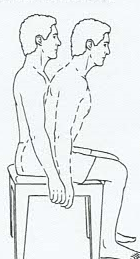
- Sit with feet flat on floor; use hands for support.
- Lean forward through hips bringing nose over knees.
- Return to starting position.
- Now, lean backward through hips.
- Hold each position 7-10 seconds.
- Repeat several times through the day.

- Sit back straight, right ankle crossed over left thigh.
- Grasp bent knee with both hands.
- Gently rotate left shoulder toward bent knee and begin to pull right knee toward left shoulder.
- Resist the knee pull by using hip muscles, 7-10 seconds.
- Maintaining position, relax, then pull knee closer to shoulder.
- Hold 7-10 seconds.
- Repeat on other side.
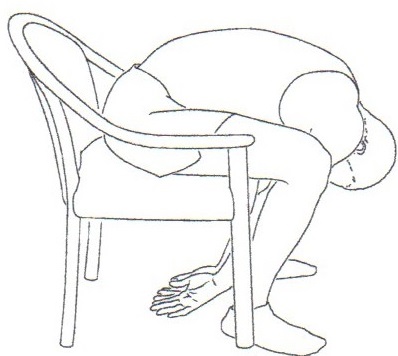
- Sit in chair with knees spread apart.
- Bend forward toward the floor.
- A comfortable stretch should be felt in lower back.
- Hold 7-10 seconds.
- Repeat several times.
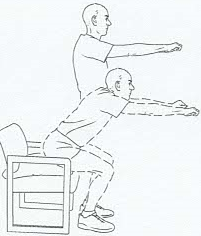
- Stand in front of chair, feet about shoulder width apart.
- Bending knees, tighten abs.
- Squat towards chair.
- Keep knees behind toes.
- Sit in chair for a few seconds.
- Tighten quads and lift from chair.
- Straighten legs to standing.
- Do this several times.
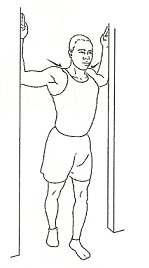
- Stand in a doorframe, palms against frame and arms at 90 degrees.
- Lean forward, squeezing shoulder blades together.
- Hold 7 to 10 seconds.
- Release, then repeat.
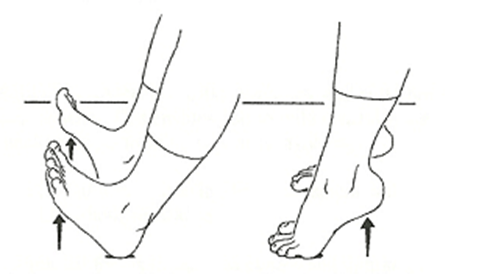
- Sitting with feet on the floor.
- Point toes up while keeping heels on the floor.
- Hold position 5 to 7 seconds.
- Now, press toes to the floor while raising heels.
- Hold position 5 to 7 seconds.
- Repeat several times.
 Nancy L. Fitness